JAPAN PLANNING GUIDE
Where to Store Luggage in Japan Before Check-in or After Check-out
Last updated: 2026-09-01
You will usually have at least one stretch of a Japan trip, arrival day, a late check-out, or a day trip, where carrying full luggage is inconvenient. Coin lockers, app-based storage networks, hotel storage, and forwarding services solve this in different ways, and the right one depends on your bag count, timing, and how far you are travelling that day. Two practical details are easy to miss until you are standing at the counter: the size and access hours of coin lockers vary by station, and confirming the specifics of a storage counter in Japanese usually needs a phone call rather than a chat app.
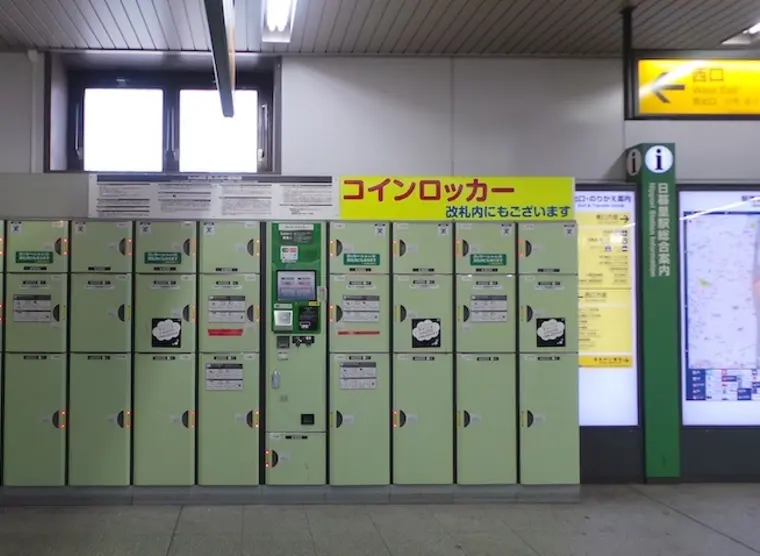
Coin locker, storage network, hotel, or forwarding?
| Option | Often useful when | Main trade-off |
|---|---|---|
| Coin locker | You need a few hours of storage near a station you are already using. | Size, price, and late-night access vary by station; not built for multi-day storage. |
| App-based storage network | Lockers nearby are full, or you want a location closer to where you are sightseeing. | You are relying on a partner business's own hours, not a 24-hour locker. |
| Hotel or ryokan storage | You are storing bags on your own arrival or departure day at that property. | Usually only available to that property's guests, and only around your stay dates. |
| Luggage forwarding | You are moving between cities or want a bag at your next hotel without carrying it. | Same- or next-day delivery, not instant, so it needs a cut-off time and buffer. |
| Shinkansen oversized-baggage seat | Your suitcase is over 160cm on three sides and you are riding Tokaido, Sanyo, Kyushu, or Nishi-Kyushu Shinkansen. | Free, but must be reserved together with the seat; otherwise a 1,000 yen handling fee applies. |
Coin lockers: the default in train stations
Most major stations have coin-locker banks, sized for anything from a small bag to a large suitcase. They are self-service and available whenever the station is open, but locations near popular sights can fill up on busy days, and station lockers are not built for multi-day storage.
Size, price, and late-night access at coin lockers
Coin lockers in Japan come in roughly four sizes: small (around 300 mm tall) for handbags and backpacks, medium (around 550 mm) for carry-on bags, large (around 840 mm) for checked suitcases, and extra-large (around 1,030 mm) for two suitcases. Basic fees range from about ¥300 to ¥800 per calendar day depending on size, with payment in ¥100 coins and, at most modern stations, IC transit cards such as Suica and PASMO. Most banks reset at midnight, not on a true 24-hour cycle, so a bag stored at 10:00 typically has to be collected before 24:00 the same day to avoid the next-day charge. Larger sizes often fill up by mid-morning at busy stations, and the maximum stay is usually 2-3 calendar days before station staff clear the locker.
App-based storage networks: more capacity, more locations
Services built on a network of partner shops, hotels, and offices let you book a spot in advance, pay online, and drop bags at a location that is not tied to a train station. This generally means more available capacity on a busy day and locations closer to where you are actually spending time, at the cost of relying on that partner's stated opening hours rather than a locker that is always accessible.
Hotel and ryokan storage
Most accommodations will hold luggage before check-in or after check-out, often at no separate charge for guests. This is usually the simplest option if you are storing bags on the same day you are arriving or leaving that property, since there is no separate booking step.
Forwarding luggage ahead (takkyubin)
Japan's courier network can move a suitcase between two addresses, for example your first and last hotel, or a hotel and the airport, so you are not carrying it on the train. This is a same- or next-day service in most cases rather than instant, so it fits a multi-city itinerary better than a same-day errand, and you should confirm the provider's cut-off time and delivery window before relying on it for a same-day connection.
Calling a storage counter in Japanese
Storage counters and ryokan front desks usually answer the phone in Japanese only, and many will not respond to email or chat for time-sensitive questions such as whether a same-day drop-off is possible, what the actual opening hours are, or how to claim a bag held under a non-Japanese name. MORISTACK does not run a storage network, but the MORISTACK Phone Call Service can place that call on your behalf and report the answer back in writing, which is the most reliable way to confirm a specific counter's hours and policies before you travel with full bags. For a longer walkthrough of hotel-side storage before check-in and after check-out, see the companion guide on the call site.
What to check before you hand off a bag
Confirm the location's opening hours against your actual pickup time, not just its listed hours for that day. Check what the service covers if a bag is lost or damaged, and keep your receipt or QR code accessible without needing mobile data. For anything time-sensitive, build in buffer rather than planning to arrive right at closing time.
Shinkansen oversized baggage rules (160-250cm)
On the Tokaido, Sanyo, Kyushu, and Nishi-Kyushu Shinkansen lines, suitcases with three sides totalling more than 160cm and up to 250cm are classified as 'oversized baggage' (tokudai nimotsu) and require a seat reservation for an oversized-baggage space at the back of the last row of the car. The reservation itself is free, on top of the normal reserved-seat fare. Bags over 250cm cannot be brought on board at all. The reservation can be made at JR ticket counters, reserved-seat ticket machines, or via SmartEX, JR-WEST Online Train Reservation, and JR-Kyushu internet booking.
JR Central and JR West started a trial on 1 July 2025 making some deck-area 'oversized baggage corners' in 16-car Tokaido and Sanyo Shinkansen trains free to use without a seat reservation, at six spots per train (cars 3, 5, 7, 9, 13, and 15). This trial applies to normal-size bags only. Bags that are still 'oversized' under the 160-250cm rule must use a reserved oversized-baggage seat, and cannot be left in these open deck corners.
If you board with an oversized bag without the matching seat reservation, JR charges a 1,000 yen (tax included) handling fee and a conductor will direct you to a specific storage spot. Strollers, wheelchairs, musical instruments, and sports equipment are exempt from the reservation rule regardless of size. Conventional JR lines are not part of this scheme. JR East Shinkansen (Tohoku, Joetsu, Hokuriku) do not have a uniform oversized-baggage reservation system; bags are placed on the overhead rack or in free deck space.
Same-day airport delivery: Airporter and Yamato Transport
Airporter is a same-day service focused on Tokyo and the Kansai area. Book by 23:00 the day before delivery. For airport to hotel, drop off at the airport counter by 13:00 on the day and the bag reaches the hotel from 20:00. For hotel to airport, drop off at the hotel front by 09:00 and pick up at the airport counter from 16:00. For hotel to hotel, drop off by 09:00 and pick up from 20:00. A separate Tokyo Station to hotel leg also exists, with pickup from 19:00.
Yamato Transport (Kuroneko Yamato / Takkyubin) runs counter-to-hotel same-day service from major airports and stations. At Haneda, the cut-off is 11:00 at the airport counter and bags reach hotels in central Tokyo from around 18:00 the same evening. A 160cm, 25kg suitcase to a hotel inside Tokyo's 23 wards costs about 5,170 yen, and about 5,780 yen to other covered areas; a separate 660 yen airport handling fee applies when an airport is the destination. Cut-offs and prices differ by terminal, so confirm on the day.
Write the hotel reservation name in Latin letters and the check-in date on the takkyubin waybill. If those details are missing, the front desk may not be able to match the bag to a reservation and will refuse it.
English-Japanese phrases to show at the counter
When a counter only answers in Japanese, a phrase shown on a phone screen is often the fastest way to get the answer you need. Three short sentences cover most situations: 'Could you please hold my luggage until check-in time today?' (本日のチェックイン時間まで、荷物を預かっていただけますか?); 'Could I leave my luggage here until [time] today after checking out?' (チェックアウト後、本日の[時間]まで荷物を預かっていただけますか?); and 'I have another reservation starting on [date]. Can I leave my main suitcase here until I return?' ([日付]から再度予約をしています。それまで大きなスーツケースを預けておくことは可能ですか?). Keep the time and date as numerals on the screen so the staff can read them at a glance.
Plan for one night without your main suitcase (micro-packing)
Same-day delivery is rarely instant, and next-day delivery is the default for inter-city takkyubin. If your main suitcase will arrive at the next hotel a day later, split your packing so a small carry-on covers the gap. The carry-on should hold passport and valuables, a change of clothes and underwear for one night, any daily medication, and a phone charger or power bank. The main suitcase takes everything else, including spares, gifts, and bulky toiletries. This way a delayed or misrouted bag does not derail a day's plans, and a multi-city trip stays comfortable without paying for a same-day special.
Before you arrive and at the counter
- Save your booking confirmation, QR, or claim code offline so you can present it without data.
- Have a payment card ready for the platform's hold or deposit if you are using an app-based network.
- Install the storage network's app and sign in before you leave home; airport WiFi is often unreliable at the counter.
- Confirm the location's opening hours for your actual pickup day and time.
- Check the size and weight the location or service accepts.
- Note what happens if a bag is lost, damaged, or you are running late.
- For forwarding, confirm the cut-off time and expected delivery window before you rely on it.
- On a takkyubin waybill, write the hotel reservation name in Latin letters and the check-in date so the front desk can match the bag to the booking.
- If your suitcase is over 160cm on three sides and you are taking Tokaido, Sanyo, Kyushu, or Nishi-Kyushu Shinkansen, reserve an oversized-baggage seat at the same time as the seat itself.
- If you use same-day delivery, pack a one-night carry-on so a delayed main bag does not derail the next day's plans.
Related guide
Decide how to handle luggage and transport together on arrival day.
Station-specific locker sizes, prices, and staffed backup counters.
Compare current storage and same-day delivery services
Open each official site and compare coverage near where you will actually be, current pricing, cut-off times, and hours for the specific location you would use.
Advertisement: MORISTACK may receive a commission if you book through this link.
Useful resources
- Japan Guide: Takuhaibin (Takkyubin) delivery services
- JNTO: Luggage & Storage (Hands-Free Travel)
- JR Central: oversized baggage on Tokaido and Sanyo Shinkansen
- JR Kyushu: oversized baggage on Kyushu and Nishi-Kyushu Shinkansen
- Airporter: same-day delivery for visitors
- Yamato Transport: same-day delivery service (English)
- ecbo cloak: Japan-focused luggage storage network
- MORISTACK Call: hotel luggage storage before check-in and after check-out
Need a Japanese phone call?
For a specific confirmation or change with a Japanese business, use the separate MORISTACK Phone Call Service.
Visit call.moristack.com →MORISTACK ではこう解決できる
If a phone call would solve it faster
For any of the situations covered in this guide (hotel, restaurant, ryokan, city office, clinic), MORISTACK Call places the call for you in Japanese and reports the answer back in English — from $6 for a single call.
Phone call, made for you
MORISTACK Call
A bilingual operator calls a Japanese business on your behalf and reports back in English. Single calls, restaurant bookings, ryokan confirmations, city-office enquiries.
See MORISTACK Call →The company hub
moristack.com
Overview of all MORISTACK services — what we ship today, what's in progress, and how to get in touch.
Visit moristack.com ↗